
Making Time for Funerals

A new installment of Journey of a New Christian. First-time reader? This introduction provides an overview. If you missed earlier installments, you can find them in this index to the series.
Returning to church 8 years ago at age 68, I naturally gravitated to people my age and older. Many acquaintances from the early years have since died. I’m ashamed to admit I never attended any of their funerals. I had dozens of excuses for not going, some of which others in my situation probably share, but they boil down to one simple gap in my theological understanding: I didn’t grasp the importance of funerals to the body of Christ and to my own faith.
This summer when Ralph died, all of that changed and I realized I had run out of excuses. Ralph was several years older than me. He wasn’t a close friend, but I often chatted with him during coffee hour. The funeral was held on a weekday morning, which meant I would have to miss several hours of work. Since I had plenty of personal leave and nothing urgent scheduled for those hours, there was no reason not to show up. Having recently been elected an elder in the church, I felt a responsibility to attend. Whatever doubts I harbored were laid to rest when my wife, a deaconness, advised, “You definitely need to be there.”
Ralph and his wife Belinda had been attending our church for about 15 years, twice as long as my wife and me, but considerably less than some others our age who had been members their whole lives. The group that turned out for visiting hours was respectable but not overwhelming. I stood in line only a few minutes before offering condolences to Belinda.
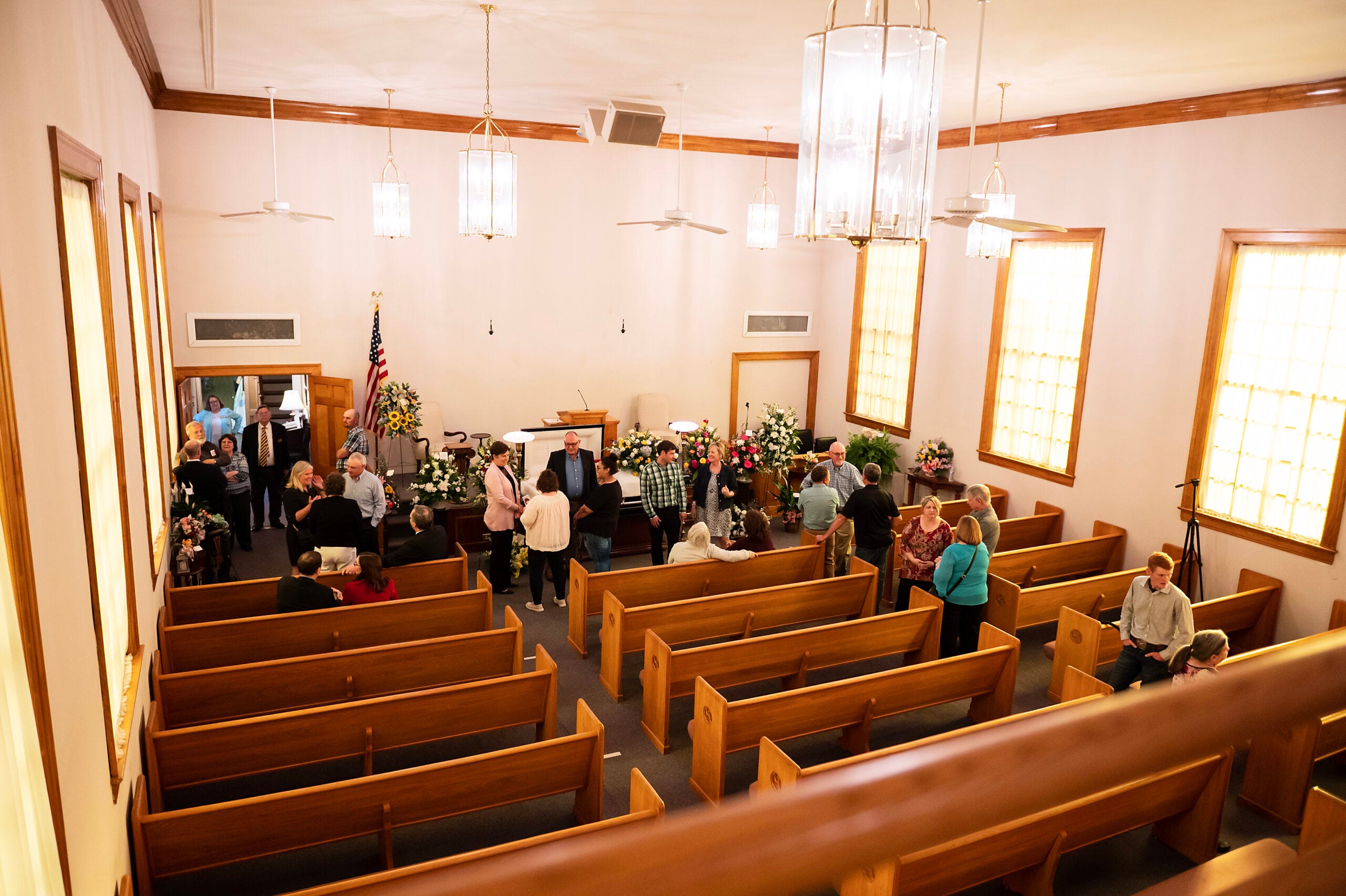
She wasn’t as distraught as I had expected. “It hasn’t hit me yet,” she explained. Afterward I heard several of the women closest to her say the same thing and wondered if they heard it from her or vice versa. She explained that Ralph had had a sharp pain in his head and sudden weakness on his left side. Since she couldn’t drive due to failing vision, he had actually driven himself to the hospital.
Getting to the hospital like this isn’t exactly what you’d expect for someone with stroke symptoms, but at least it got him within range of medical care quickly. That advantage evaporated, however, when he was made to wait for 4 hours in the local emergency room before a doctor could see him. If that isn’t a legitimate reason for a lawsuit, I don’t know what would be.
Now, of course, wasn’t the time to raise this with Belinda. The seats in the visitation room were all occupied, so after chatting for a few minutes with her and her sons, I made my way to the sanctuary to wait for the service to begin.
The senior pastor was away that week, visiting his son and new granddaughter on the other side of the state. That left Pastor Tim, the associate pastor, a much younger man, to officiate at the service. I wondered how he would do. His sermons were always well-crafted, but he worked mainly with youth and young adults. Would he be able to relate to the older demographic that Ralph represented?
I needn’t have worried. He appeared poised, relaxed, and confident as he led us in prayer, then read aloud from Romans and 2nd Corinthians. The songs he’d picked for the service were old standards we’d sung every few weeks for as long as my wife and I had been going to this church. Today they sounded fresh and new. It took me a few stanzas to realize this was because the full praise team band wasn’t there, just Pastor Tim with his acoustic guitar. Without the pounding of drums and electric guitars, I could hear people around me singing and enjoyed how their voices blended with mine.
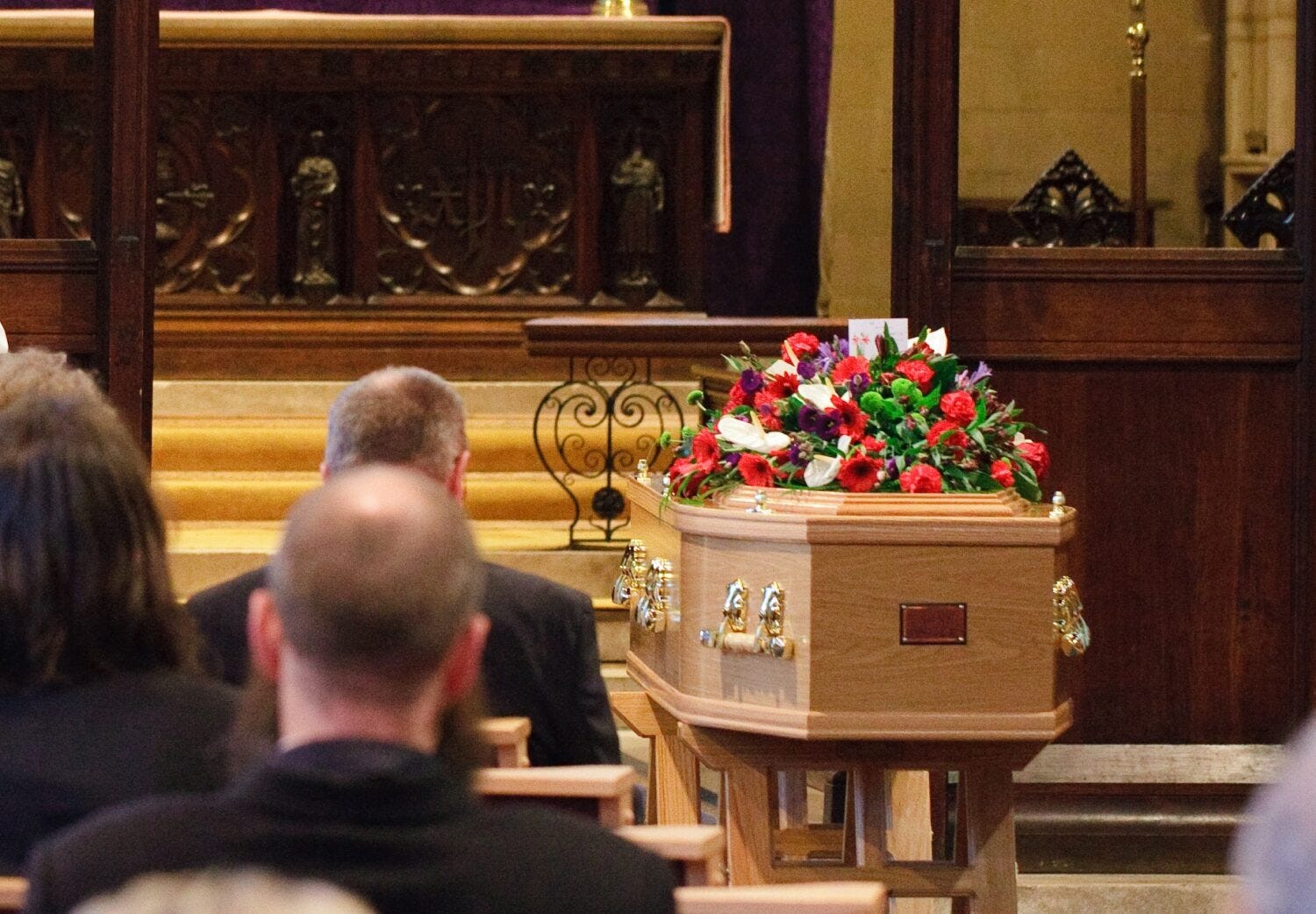
From Pastor Tim’s eulogy, it was clear that he’d listened carefully not only to the reminiscences of family but to Ralph’s friends in the congregation as well.
The Ralph I knew was preoccupied with the challenges of his daily life—rent increases, icy sidewalks, noisy neighbors, the difficulty of getting in to see a doctor. Life was getting hard for him and his wife. Her vision was very limited. He suffered cognitive decline and had difficulty tracking and problem solving, which sometimes made it difficult for him to follow the conversation. I didn’t mind him being engrossed in his own problems. I appreciated his openness, and his habit of putting a humorous spin on just about anything that went wrong in his life. Though our backgrounds were very different, I never worried about feeling self-conscious or having to struggle to make conversation when I sat down with him.
From the eulogy, I learned that Ralph’s demeanor and outlook had been very different when he first came to the church. In those days he worked as service manager in a car dealership. He was a fount of knowledge and could identify parts for every make, model, and year that passed through the garage he oversaw. He and Belinda had been far more active in service than I have been—their past contributions to the care, finance, and leadership teams were well known and widely respected. As they grew older, though, all kinds of physical and financial problems intruded, and by the time I met them, they were no longer able to serve. Ralph’s wry humor was his gracious response to what must have seemed like an undeserved and increasingly onerous array of burdens.
I knew that Belinda had children from a previous marriage, and that Ralph had none of his own. What I did not know was that when they married she had three young boys, kindergarten age and below, whom he helped to raise as if they were his own. Not having heard him mention the boys, I had erroneously assumed the connection was slight, but now I realized Ralph didn’t talk about them now because he was preoccupied with basic survival. Evidently he’d been close to the boys, played with them, and taught them how to build and repair things, including how to work on cars. What a blessing he must been to that family! What would have become of them without Ralph’s love and attention, not to mention his salary?
I felt a pang of sadness when Pastor Tim mentioned Ralph’s enthusiasm for model trains. He’d told me once how much he enjoyed train shows. By then he was slipping. I knew getting around was harder for him, and I knew his cognitive decline was frustrating for Belinda, so I offered to take him to one of those shows if it came to town.
I’d forgotten that promise, and I guess he had as well. A few months before he died he mentioned he’d gone to one to sell some of his equipment, which he no longer had room for in the smaller apartment that he and Belinda had moved into.
I’d known Ralph in his early eighties, but the picture of him unfolding now in the eulogy was like meeting an entirely new person. When Pastor Tim moved on to Christ’s promise of eternal life, I wondered if this was the person I’d know in the kingdom of heaven—not just a slice of him, but a composite of all the good things in his life. I hoped, too, that he would become acquainted with the whole of me and not just the shell of awkward respectability he saw at coffee hour on Sunday morning. Strange as it seems, this was the first time life in the kingdom of heaven had become real to me. I couldn’t imagine what it would be like to see the resurrected Jesus, but I could readily imagine, after Pastor Tim’s eulogy, what it would be like to see the resurrected Ralph.
As the service concluded, the ushers approached the casket, preparing to maneuver int into place for its journey down the center aisle and into the hearse. Pastor Tim stepped out, put his hand on the casket, and said something to one of the ushers. They stopped. A slight middle-aged man had stepped out of the front pew. It was one of Ralph’s sons.
Apparently he had been hesitant to speak during the service, but now he had reluctantly decided he ought to.
“Dad really loved us,” he said slowly in a tremulous voice.
He began to talk quietly about what Ralph had done, all the things he had fixed around the house, and how he and his brothers watched, helped, and learned from him. One memory stood out vividly in his memory—of Ralph trying to replace a cracked windshield on the family station wagon. He was struggling with the seal when the new windshield broke. The boys could feel his frustration, and they felt tension mount when he returned from the dealership with another new windshield, maneuvered it into place, and went to work on the seal. That one broke too. Ralph stood there not speaking, and the boys looked at one another, wondering what was going to happen next. After Ralph went back to the dealership and returned for a third try, they made themselves scarce, so they never knew what the outcome was. But I did.
Ralph persevered. He kept his temper. If there had been some kind of explosion of anger, the boys would have known about it and remembered it. Ralph was true to his purpose, to take care of his family. One way or another, the windshield got fixed. I like to think that the next day at work, he told his employees the story, with the wry smile that signaled he didn’t know why life was so hard, but that he had no choice to move forward and do what he had to do anyway.
After the service, everyone was invited to lunch in the church basement. I had one meeting at work that day that would have been complicated to reschedule, so I didn’t go down for the meal. Afterward I regretted it. My wife, who helped with the food preparation and service, told me how good it was and brought home some of the leftovers.
A month later, when another member of the church, Emma Lou, died, I remembered about lunch and arranged to stay later. What my wife said about the food was true. Everyone on the care team had contributed their special dish. But food wasn’t the main attraction that day. Several people at the table where I sat shared memories of Emma Lou that amplified what Pastor and family members had said at the service. I was amazed at the depth of connections among people who had been in church the whole of their lives. Compared to Ralph, I knew Emma Lou only slightly, but the rich, full life described by Pastor, daughter, granddaughter and the friends at my table offered perspective far beyond anything I could have gained through normal social encounters. The love and encouragement this woman had strewn in her path over 88 years was truly inspiring. It was a picture that left me wondering what sort of impact my own life has made on people around me.
Driving to work that afternoon, I found myself wondering if I’d had a glimpse of Emma Lou and Ralph as God sees them—as two faithful people, who despite differences in their lives and circumstances, had both been touched by the Holy Spirit and lived lives infused by Christian love. If indeed that is how He sees them, how does He see me? What picture of me will church members, family, and friends carry with them after my funeral?
These are questions I’m not sure I want the answers to right now, but I take comfort in the hope that I have time left to become the person I’d want to be remembered as. In the meantime, I’m conserving vacation days, so I’ll be able to join with fellow believers to honor anyone among us who dies, even if it’s someone I know only slightly.
If you click the “like” button, you’ll help other readers find this post.