
Scripture and Cognitive Friction

A new installment of Journey of a New Christian. First-time reader? This introduction provides an overview. If you missed earlier installments, you can find them in this index to the series.
As a college administrator, I’m often called on to lead discussions of new teaching methods. One issue that often comes up these days is how to use AI in our classrooms. Recently my long-term colleague, a professor of psychology, proposed that AI should be used for teaching if and only if it increases cognitive friction for students.
I’d never heard the term before. When the professor explained it, my ears perked up and I realized the concept would apply to how the Bible is written and how it is read.
What is cognitive friction?
We’re all familiar with friction in the physical world—the amount of effort required to move one object that is in contact with another. Another way to think of it is the stickiness between the objects.
The friction between car tires and the road illustrates the positive and negative effects of friction. The right amount keeps cars from sliding, enabling the driver to maintain control while turning, braking, or accelerating. Too little friction, resulting from icy roads or bald tires, can send a vehicle into a tailspin. Too much will wear out the tires and burn extra fuel.
Think of cognitive friction as the mental equivalent of tires on a road surface. If something is familiar, cognitive friction is low. You don’t have to spend much mental energy to figure it out. For example, if you’re reading something familiar, you can practically skim over the text. You don’t have to think very hard. But if it’s a new topic with vocabulary you haven’t seen before, you’re going to have to work harder. If the text is dense or obscure, you may not get anywhere and be tempted to quit. If, however, you’re able to make headway, you’ll find the work easier. The unfamiliar is becoming familiar. That is an indication that you’re learning.
My colleague worries that students use AI to make assignments easier and in doing so short-circuit learning. Suppose an instructor assigns a paper comparing critical responses to Moby Dick. The students plug the assignment into Chat GPT. Voilà: a perfect paper, complete with footnotes and a bibliography. A grade is awarded but the student has learned nothing.
These comments got me thinking about the Bible. How does cognitive friction work as we seek to understand God’s word? Does the concept teach us anything about how the Bible is written or how we go about daily reading?
Cognitive friction in the way the Bible is written
In his sermon on Melchizedek, John Piper reminds us that some parts of the Bible are simple. Even children can understand them. Others are more complex. You have to struggle a bit: interpret, analyze, compare, reason, ask questions. In short, you have to do all those things that embed content in memory, that produce learning that lasts.
As Paul reminds us, “All scripture is breathed out by God and profitable for teaching . . . and for training in righteousness” (2 Timothy 3:16). Whatever complication we find in the text is by God’s design. It shows that He wants to challenge us and encourage deeper learning.
The subject of Piper’s sermon, Melchizedek, is a perfect example. What figure in the Bible is more obscure than the great priest-king who blessed Abraham after his defeat of the four kings? (Genesis 14: 18-20)
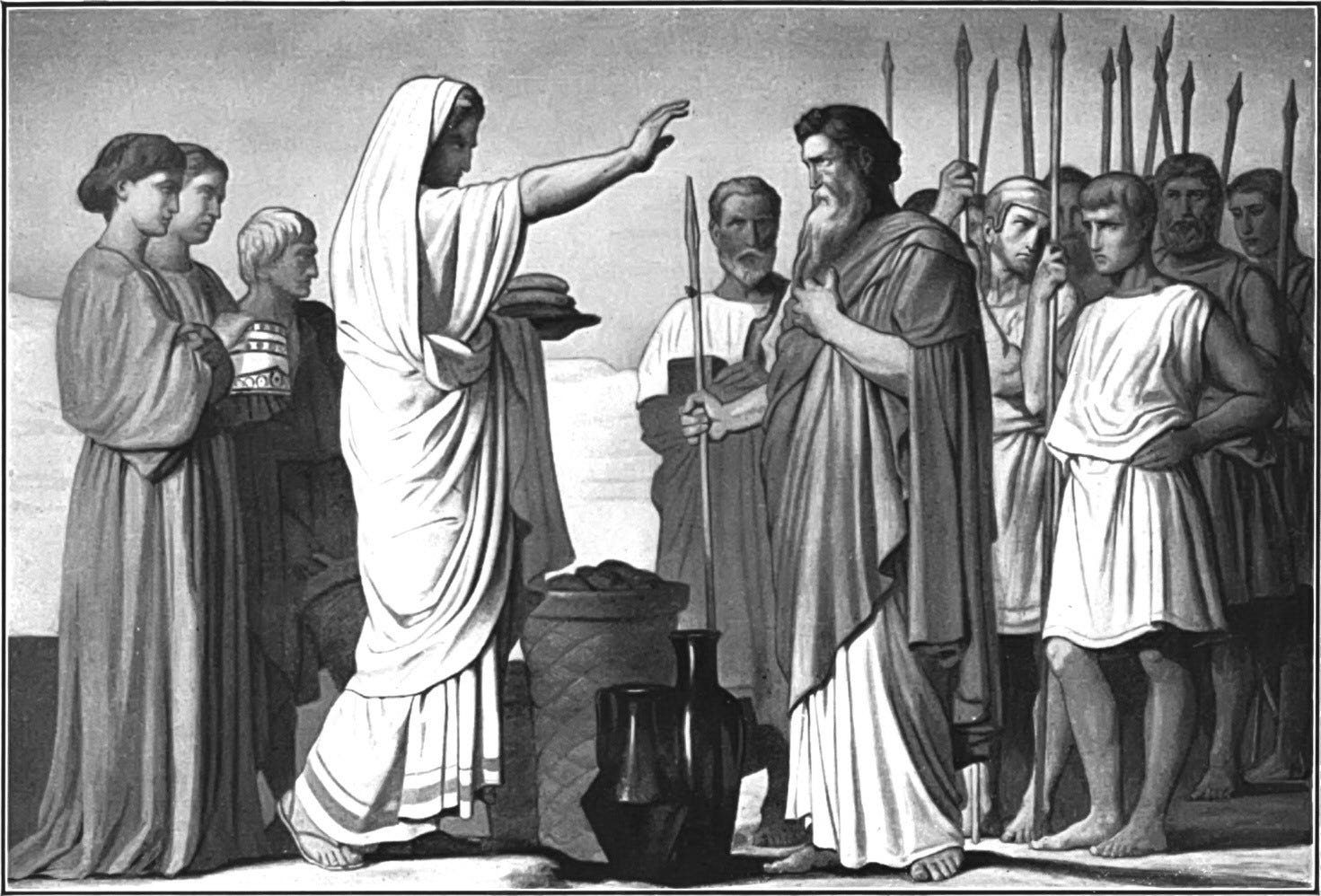
As Piper points out, we don’t know where Melchizedek came from or who his ancestors were. Nor do we know what became of him—who his descendants were, whether Abraham ever saw him again, or whether he played any further role in the struggles of God’s people. In fact, we don’t hear anything more about him for over 1,000 years, when David describes Christ as “a priest forever in the order of Melchizedek” (Psalm 110:4). Another thousand years pass before the author of Hebrews refers to him as “king of righteousness” and “king of peace” (Hebrews 7:2).
Who is this mysterious figure? Where does he come from? What does he point toward? To say the least, his appearance three times at thousand-year intervals is a puzzle. If we notice it, we’re inclined to try to fit it together, as Piper does in his sermon. This little tug of curiosity, if we let ourselves feel it, is cognitive friction. This is the kind of friction that stimulates learning.
The story of Melchizedek attests to cognitive friction across the broad span of the Biblical narrative. But that friction is also found in individual verses, as we see in the book of Proverbs. Most verses in Proverbs are couplets, consisting of either contrasting or parallel aphorisms. We expect the aphorisms to match, but they often don’t. As readers, we have to fill in some of the reasoning. No doubt the young people to whom the advice is addressed had to do likewise.
Consider, for example, Proverbs 13:5, which begins, “The righteous hates falsehood, but the wicked. . . .” We expect the predicate to reference falsehood: for example, “lies continually” or “avoids truth like the plague.” No friction there: the reader can glide right over it without thinking. The actual predicate, “brings shame and disgrace,” is more challenging. It doesn’t stop with the attitude of the wicked, as the first clause does for the righteous. It moves two steps ahead—from attitude to conduct to consequences.
This skipping ahead occurs continually in Proverbs. The effect of it is to make readers work harder. The disparity between the two halves of the couplet creates cognitive friction. We can’t just sit back and wait for the author to make his point. We have to do some of the work to fill in his logic. It’s the kind of work that leads to learning, if we don’t shy away from it.
What is true of these instances is also true of the Bible as a whole. God’s plan of salvation is not disclosed all at once. It unfolds gradually, through progressive revelation. You can’t just glide through the text, you have to keep track of how each new piece of the puzzle fits in with what’s already been revealed. The text is shot through with allusions to earlier passages. If you’re willing to put in the time, tracing these references deepens your understanding and results in greater learning.
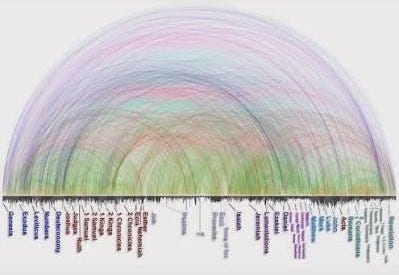
When you get to the New Testament, the pressure to track these references increases exponentially. Scholars disagree about how often the New Testament refers to the Old. One well-respected evangelical website, Blue Letter Bible, estimates that there are 933 instances of direct quotation, paraphrase, and allusion.
These references represent the core of New Testament thinking. The principal aim of the gospels and the pastoral letters that follow is to show that Jesus is the Christ. Besides the miracles and Jesus’ own promises and predictions, the main way they do this is by showing that Jesus fulfills Old Testament prophecy. Jesus himself uses Old Testament references to rebut the skepticism of Jewish leaders, and Paul and other apostles rely heavily on the same logic to defend the faith throughout the known world, especially to members of the Jewish diaspora.
The vital role of Old Testament references in spreading the gospel is demonstrated by Luke’s description of the Berean Jews as being “of more noble character than those in Thessalonica, for they received the message with great eagerness and examined the Scriptures every day to see if what Paul said was true” (Acts 11:17). “Scriptures” here refers to what Christians now call the Old Testament; the New Testament hadn’t been written yet. Berean Jews did not take what Paul told them about Christ at face value. They tested it against prophecy. By making new claims that they could not accept at face value, Paul introduced cognitive friction, which ensured that his words would not only be heard but weighed with care and ultimately remembered and valued.
We don’t have to rely on the evidence of apostles and prophets to see how cognitive friction is built into God’s word. Throughout His ministry, Jesus Himself relies heavily on this teaching technique. Using metaphors, predictions, and parables, He challenges all whom He encounters to rethink their view of the world, acknowledge His divinity, and recognize the dawn of a new age brought about by the incarnation. “I am the vine/bread of life/good shepherd/door/light of the world,” he announces at various times to various audiences, puzzling them and prompting all who hear to try to figure out what He means. His preferred self-designation “Son of Man” is deeply ambiguous, perplexing to all those who know that in fact, He is the son of God.
The predictions—tearing down and rebuilding the temple, going where disciplines can’t follow, being betrayed by a close friend, being denied by a faithful disciple—were deeply troubling to those who heard them. In most cases they were not meant to be understood until the prediction came true.
Many of the parables required explanation, often to a smaller more intimate group like the disciples. But even those Jesus didn’t explain posed a challenge to His audience then and still do to readers today. The point of a parable may be obvious, but we still have to work out how it applies to our own lives. If anyone has doubts about whether cognitive friction plays a role in God’s word, even a brief exposure to Jesus’ ministry should be enough to lay them to rest.
Cognitive friction in Bible reading
The Bible is a work of immense complexity. When you read it for the first time, it can be overwhelming. You can read hours a day all your life and still not grasp all its intricacies. If you’ve read through it many times, you may be tempted to glide over the familiar passages and not worry to much about the parts you don’t understand.
If you want to make progress, learn, and keep on learning, you have to strike a balance between gliding through and getting stuck over the hard parts. You need the right level of cognitive friction, a level that will keep the car on the road, neither so much you get frustrated and give up nor so little you spin out and learn nothing.
In the beginning, when I decided to read the Bible all the way through, I knew I was in for a stiff challenge. Much of the content was unfamiliar, and I had only a hazy idea how it fit together. As I forged ahead, I realized I wouldn’t understand all of it. There were parts I read through without grasping much at all—for example, the genealogies in Genesis and the woe proclamations in Isaiah. But even in the beginning, I did have a way to dig in and grapple with what I didn’t understand.
I’d chosen the NIV Cultural Foundations Study Bible, a thick volume with maps, diagrams and detailed explanations of the culture and history of the ancient Near East. Instead of just struggling along verse by verse, I forced myself to look at these other materials and use them to make sense of what the text said. That took longer, but it helped me visualize the setting and understand what was happening.
Chuck Missler, a former engineer turned Bible teacher whom I greatly respect, advocates keeping a notebook for questions that come up when you read scripture. I didn’t do this until I’d been reading the Bible daily for nearly 6 years. Up to that point, what I didn’t know or understand was so vast that writing it down would have been overwhelming. I needed to get to a point where I understood the broad outlines before I knew what questions to ask. As you probably know if you’ve been following Journey of a New Christian, I reached that point only recently.
As my knowledge has slowly grown, I’ve changed my strategy to make sure I’m still engaged with the text, still working to make sense of it, still learning. God is omniscient. His word is inexhaustible. There’s so much in that book that He gave us that I don’t fear coming to the end of it. As I learn more, I just have to keep ratcheting up the level of cognitive friction.

There are many benefits to daily immersion in God’s word: comfort, obedience, reassurance, being reminded of whom we worship and who should take center stage in our lives. But the spark that animates me every day—the one guarantee that the daily routine of Bible-reading doesn’t get stale, the one sure motivation that draws me back to the Bibles and commentaries stacked on the end table where I have my morning coffee—is the confidence that I’ll learn something new today, tomorrow, and for all the days afterward.
Clicking “like” makes this post accessible to more readers. Thanks in advance for taking the trouble!